Whole House Surge Protection in Boise, ID

Surge protective devices installed at the service, sized and specified for a grid that sees wind events, wildfire switching and summer transformer stress.

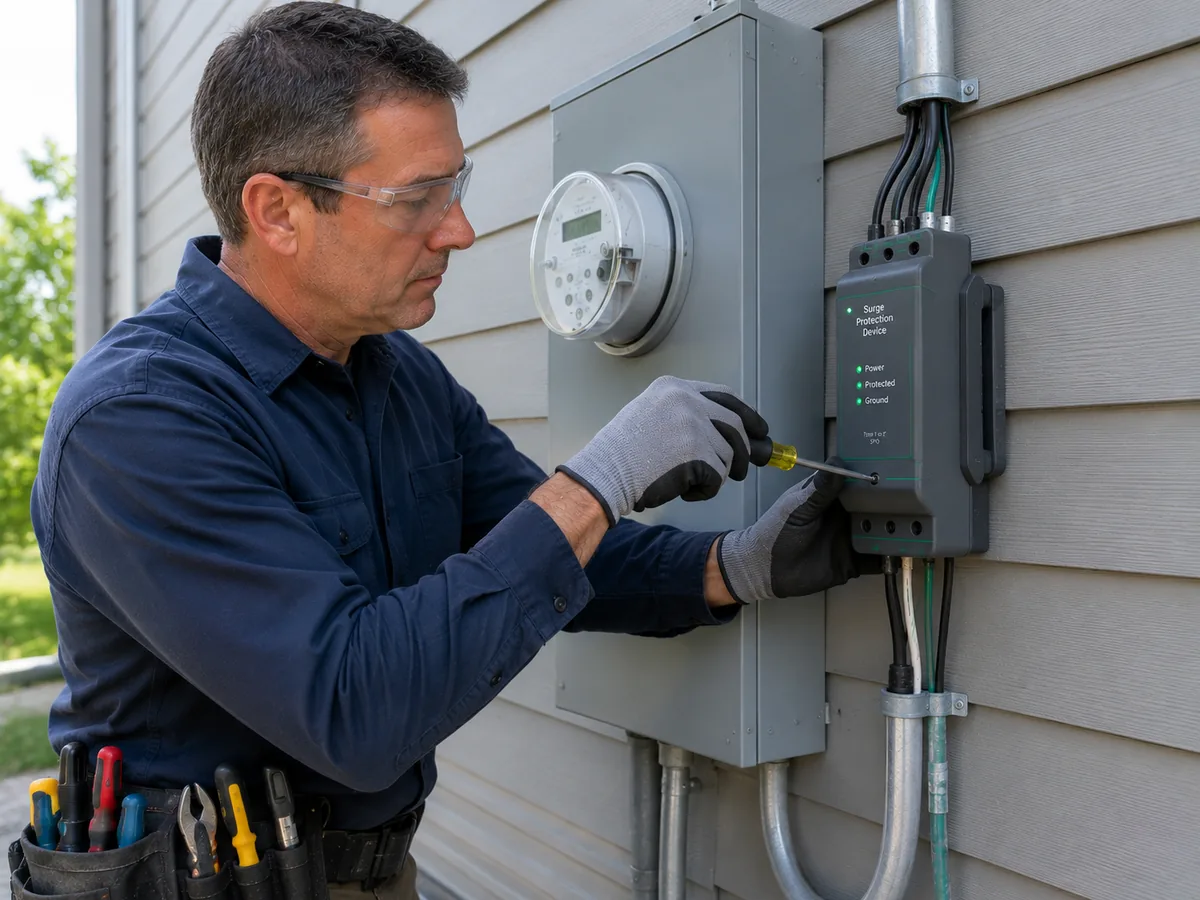
Electrician installing a surge protective device beside the meter and service panel on the exterior of a house

Last updated: September 24, 2026

Boise Electrician Experts connects homeowners with licensed electrical contractors installing whole house surge protection across Boise and the Treasure Valley. A whole house surge protector in Boise is a surge protective device installed at the service, where it clamps transient overvoltage before it reaches branch circuits. It is one of the few electrical upgrades that is cheap relative to what it protects, and on a grid that sees frequent protective switching during fire season it earns its place.

What we do on the first visit

Every whole house surge protection job starts the same way: we look before we quote. You get the cause in writing, a price that does not move once work begins, and the permit filed by us rather than by you.

  • Test the ground first. A surge device can only divert energy to a good ground. We check the electrode system before quoting a device.
  • Size to the service. Device rating matched to your service and to what is downstream, including any generator interconnection.
  • Mount with short leads. Lead length directly degrades clamping performance, so we mount for the shortest practical conductor run.
  • Explain the indicator. SPDs are consumable. We show you the status light and what it means, so a spent device gets replaced.

What actually threatens electronics on this grid

Boise's surge risk profile is not the lightning-dominated one most surge protection marketing assumes. Southwest Idaho does get summer thunderstorms, but the more frequent threat is switching.

During elevated fire risk Idaho Power increases the sensitivity of devices that automatically de-energize lines and limits automatic re-energization of tripped circuits. That means more protective operations, and every one of them is a switching event on the distribution system. A Public Safety Power Shutoff adds a planned de-energization and a controlled restoration at the end. Each transition is an opportunity for a transient.

Summer adds a third mechanism specific to a fast-growing valley: irrigation load and cooling load converging during heat waves, which has produced localized transformer failures in the Boise-Kuna corridor. A failing transformer is not a clean loss of power; it can deliver abnormal voltage before it goes.

The equipment at risk is not what people expect either. A surge strip at the desk protects what is plugged into it. It does nothing for the HVAC control board, the heat pump inverter, the oven logic board, the well pump controller or the LED drivers in your ceiling fixtures — all of which contain electronics and all of which are hardwired.

The grounding problem that makes surge devices useless

A surge protective device works by diverting energy to the grounding electrode system. If that system is inadequate the device has nowhere to put the energy and its clamping performance collapses. This is not a marginal effect; it is the difference between a device that works and an expensive indicator light.

Older services in this valley fail the test regularly, and for a reason worth knowing: a great many rely on a water-pipe bond that stopped being a ground the day a section of metal service line was replaced with plastic during a repair. That is invisible from inside the house. Ground rods driven decades ago in the valley's alkaline soil also corrode at the connection, which is usually buried and has never been inspected.

So the electrode system gets tested before a device is quoted. If the ground needs work, that is part of the scope, and installing an SPD without it is not worth your money. This is also why surge protection is cheapest bundled with a panel upgrade, when the grounding is being brought to NEC 250 anyway.

What is included

  • Grounding electrode system inspected and tested first
  • Type 1 or Type 2 SPD listed to UL 1449, sized to the service
  • Device mounted with the shortest practical lead length
  • Bonding verified per NEC Article 250
  • Point-of-use protection recommended for sensitive equipment
  • Coordination with any generator or solar interconnection
  • Status indication explained so you know when it has done its job
  • DOPL permit where the panel work requires one

What you should expect to pay

We quote surge protection on site because the price depends on whether your panel has the space and bus configuration for a listed device, and on whether the grounding electrode system is adequate. A surge device bonded to a poor ground is decoration.

Component we can publishRange
Licensed electrician, hourly$80 - $140 per hour
DOPL electrical permitScaled to job value

DIY, cheapest bid, or permitted work

What you are comparing DIY or handymanCheapest bidPermitted, code-compliant work
DOPL permit and inspection Idaho does let a homeowner permit work on their own home, but most skip it entirely and the work is never inspected.Often skipped to hit the price. The liability lands on you.Permit purchased from DOPL, inspection scheduled and attended, record on file with the state.
Insurance position after a fire Unpermitted work is a common basis for a reduced or denied claim.Same exposure. An invoice does not prove code compliance.A passed state inspection is documentary evidence the work met code.
Which code edition it was built to Whatever the internet said. Usually an older edition.Quoted to the cheapest interpretation, not the adopted one.Idaho's adopted 2023 NEC with the Idaho amendments in force at permit application.
GFCI and AFCI placement Added where convenient, not where the code requires.Minimum devices to survive a glance.Placed per NEC 210.8 and 210.12 for the actual room use.
Load calculation None. The panel is sized by guess.Rule of thumb, which routinely undersizes for heat pump plus EV.NEC Article 220 calculation on paper before anything is ordered.
Lead-safe practice in pre-1978 homes Not considered. North End plaster is almost certainly lead-painted.Rarely priced in.Containment and cleanup appropriate to the age of the house.
What happens at resale Turns up in the inspection report and becomes a price negotiation.Same, with no permit record to show the buyer.State permit record and sign-off transfer with the house.

Our process for whole house surge protection

Test the ground first

A surge device can only divert energy to a good ground. We check the electrode system before quoting a device.

Size to the service

Device rating matched to your service and to what is downstream, including any generator interconnection.

Mount with short leads

Lead length directly degrades clamping performance, so we mount for the shortest practical conductor run.

Explain the indicator

SPDs are consumable. We show you the status light and what it means, so a spent device gets replaced.

Get a written price for whole house surge protection

Call and describe the job, or send a photo. We give you a number in writing before any work starts, and we pull the permit ourselves.


Frequently asked questions

Does a whole house surge protector stop lightning?

It handles the induced transient, not a direct strike. What an SPD is genuinely good at is the far more common case here: switching transients from protective operations during fire season, restoration after a PSPS, and transformer stress during summer peaks. Those are frequent and they quietly kill electronics.

How often does it need replacing?

It is a consumable. Every transient it absorbs uses some of its capacity, and after a large event or a long service life it will indicate as spent. Check the status indicator after any significant grid event — a device that has done its job and not been replaced is protecting nothing.

Type 1 or Type 2?

Type 1 is rated for installation on the line side of the service disconnect, which includes meter-socket and exterior mounting. Type 2 installs on the load side, at the panel. Both are legitimate; which one suits depends on your service arrangement and where there is room. A contractor should tell you which they are proposing and why.

Do I still need surge strips?

Yes, for sensitive equipment. Service-level and point-of-use protection do different jobs and belong in series. The service device takes the large external transient; the strip handles the remainder and the smaller transients your own motor loads generate inside the house.

Who pulls the permit in Idaho, and is it from the city?

The contractor pulls it, and it comes from the state rather than the city. Idaho electrical permits are issued by the Division of Occupational and Professional Licenses and purchased online. This catches people out: a City of Boise or Ada County building permit does not replace the DOPL electrical permit, and you may need both. Idaho does allow a homeowner to purchase a permit for work they perform themselves on their own primary or secondary residence, but not for commercial property and not for a rental.


Request a callback about whole house surge protection

Two short steps. Same-day callback.

So we can tell you the realistic arrival window.

In a hurry? Calling is faster — 208-856-4826

208-856-4826Same-day callback