Last updated: September 24, 2026
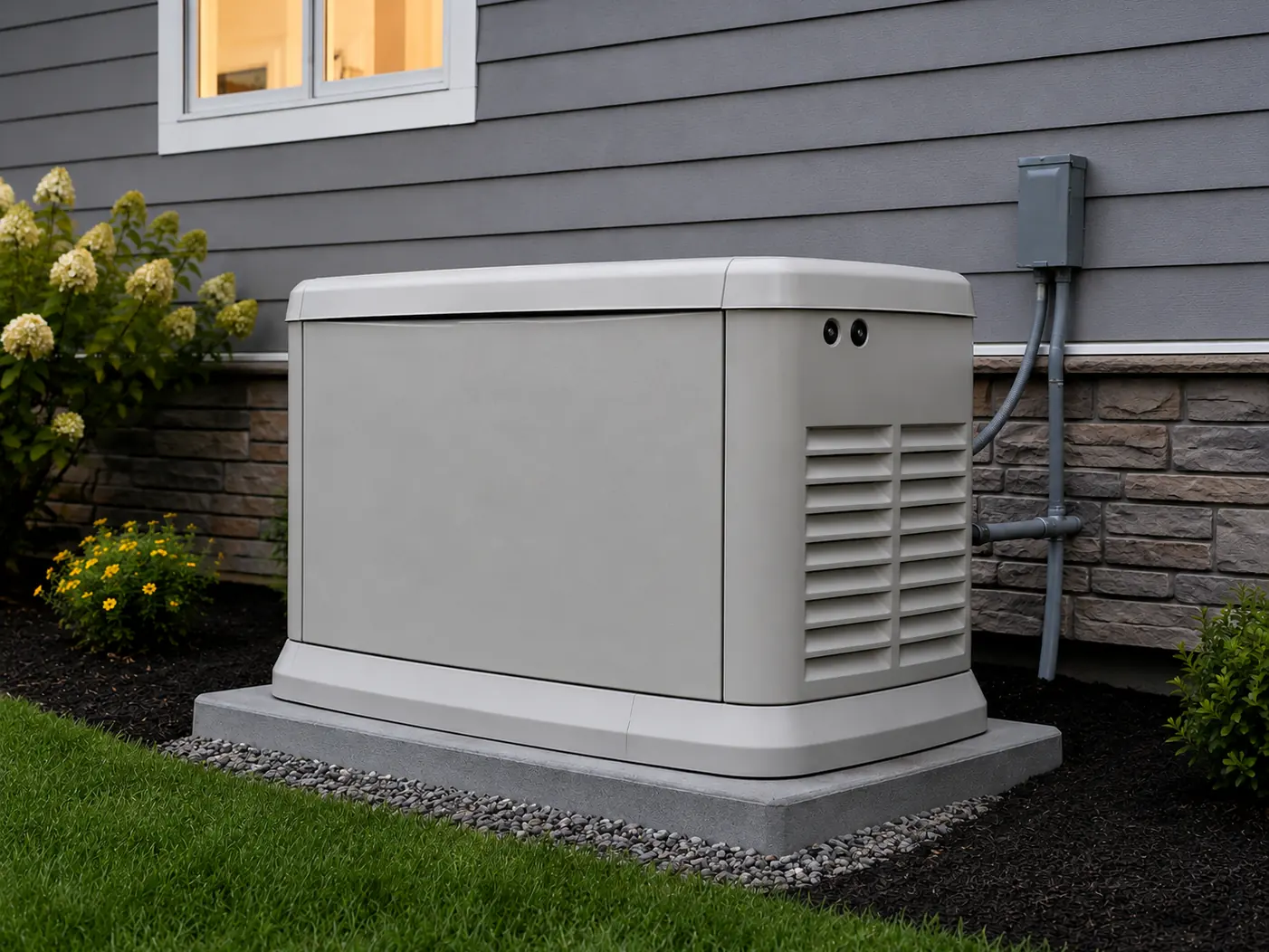
Boise Electrician Experts connects homeowners with licensed electrical contractors installing permanently mounted standby generators across Boise and the Treasure Valley. Whole house generator installation in Boise is a multi-trade job: an electrical scope, a fuel-gas scope, a pad, a DOPL permit and an Idaho Power notification. The generator itself is often less than half the installed cost, which is why a quote naming only a model number is not a quote.
What we do on the first visit
Every standby generator installation job starts the same way: we look before we quote. You get the cause in writing, a price that does not move once work begins, and the permit filed by us rather than by you.
- Load study first. We measure and calculate what you actually need to run, then decide whole-house or managed essential loads.
- Site the unit and the fuel. Clearances, gas line capacity or propane tank placement, and the trench route back to the panel.
- Install and interconnect. Pad, unit, transfer switch and the panel work. Permit and utility notification handled.
- Commission under load. We kill the utility feed and prove the transfer works with your real load on it, then walk you through it.
PSPS: the outage you can plan for, and most people don't
Boise's standby power case is different from most of the country's, and better, because the outage that matters most here is announced in advance.
Idaho Power operates a Public Safety Power Shutoff program: when high wind combines with dry fuel, it preemptively de-energizes lines rather than risk an ignition. The first time it used that authority in the Boise area, more than 8,000 customers across the north and east edges of the city lost power during a heat wave that had topped 99 degrees for a record 17 consecutive days. Customers were texted an estimated duration of 8 to 16 hours. Roughly 55,000 customers received warning notices that morning. The highest-risk areas named were the Boise Foothills, southern Ada County, and rural communities including Emmett, Homedale and Parma.
Two things follow. First, if you live in the Foothills or on the valley's rural edges, you should expect this again — it is a standing operational tool, not a one-off. Second, a PSPS is the one outage where a standby system pays for itself predictably: you know it is coming, it lasts most of a day, and it tends to arrive during the exact heat that makes losing air conditioning worst.
Winter brings the other mechanism. Riming — heavy frozen mist accumulating on conductors — and snow loading put mechanical stress on lines, and restoration in terrain can be access-delayed. A January outage in a house with a heat pump and no wood stove is a different kind of emergency.
Sizing: whole-house is not always the right purchase
The instinct is to buy a generator that runs everything. It is frequently the wrong purchase. The alternative is a smaller unit paired with load management that automatically sheds non-essential loads — typically the electric water heater, the dryer and one HVAC zone — whenever demand would exceed capacity.
Load shedding lets a materially cheaper unit carry a larger house for most of an outage, at the cost of intermittent operation for the managed loads. In this climate the decision usually comes down to two things. In summer it is air conditioning: a condenser's starting inrush is several times its running current, and a generator sized on running watts alone will stall trying to start it. In winter it is heat pump backup: electric resistance strip heat is a very large continuous load, and sizing a generator to run it is a much bigger unit than sizing one to keep the house above freezing with the compressor alone.
For rural and foothills properties there is usually a third: the well pump. A house with no water is uninhabitable much faster than a house with no air conditioning, and well pumps have their own substantial starting current.
The transfer switch is the part that matters
An automatic transfer switch senses the loss of utility power, starts the generator, waits for it to come up to speed, and only then transfers your panel from the utility feed to the generator output. When utility power returns it transfers back and runs a cooldown. You do nothing.
The safety function is the important one: the switch makes it physically impossible for the generator to be connected to the utility at the same time. Backfeeding a de-energized line through an improvised connection puts lethal voltage onto conductors that Idaho Power crews are working on. During a PSPS, when crews are actively patrolling lines before re-energizing, that risk is not hypothetical. A permitted install with a listed transfer switch removes it entirely.
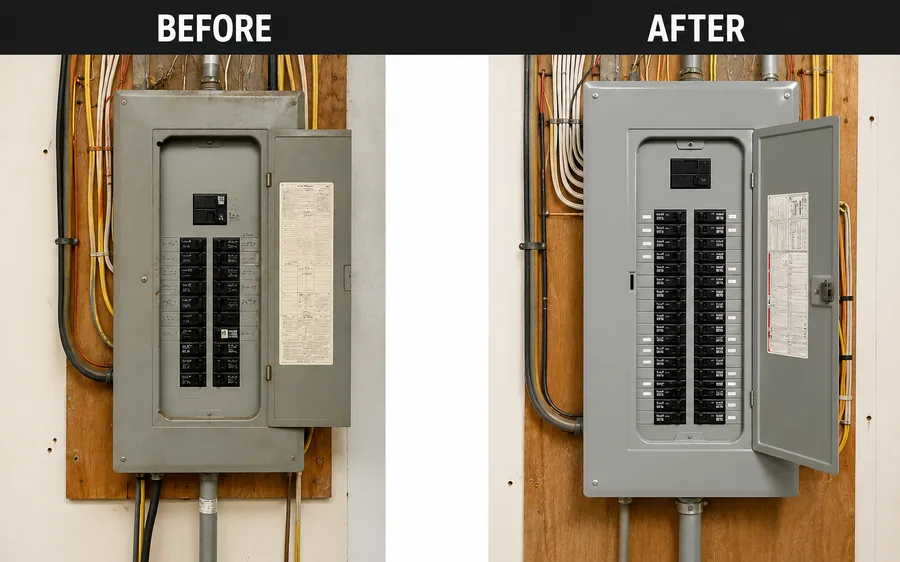
Two decisions get made here. A service-rated transfer switch sits ahead of the panel and covers the whole service; a subpanel arrangement backs up a chosen set of circuits. And the switch has to be sized to the service, which is why an undersized or obsolete existing panel frequently becomes part of the generator scope rather than a separate project.
What is included
- Load study to decide whole-house versus managed essential loads
- Generator sizing against the calculated load, not square footage
- Automatic transfer switch specified, supplied and installed
- Pad siting checked against NEC and manufacturer clearances
- Fuel supply coordinated: natural gas line sizing or propane siting
- Load-shed management where a smaller unit can cover a larger home
- DOPL permit filed and Idaho Power notified of the interconnection
- Commissioning, transfer test under load and an owner walkthrough
What you should expect to pay
We do not publish a headline generator price, because any number that ignores fuel type, tank siting, trenching distance, pad work, transfer switch class and the condition of your existing panel is a number you will not end up paying. What we can publish are the components that make up the total, below.
| Component we can publish | Range |
|---|---|
| Panel upgrade, 100A to 200A | $1,500 - $4,000 |
| DOPL electrical permit | Scaled to job value |
| Licensed electrician, hourly | $80 - $140 per hour |